

Many readers want to stop subvocalising because they have heard it slows reading down.
Subvocalising is the inner voice you hear when reading silently. It is the habit of mentally saying words as you read them. Some people notice it clearly. Others do it without realising.
The important thing to understand is this: subvocalising is not always bad, and you do not need to remove it completely.
For some reading tasks, inner speech helps comprehension. For other tasks, relying on it too heavily can slow you down. The goal is not to silence your mind. The goal is to use less inner speech when the text allows it, while still understanding what you read.
For the broader overview of how this fits into reading efficiency, read our guide on what speed reading is.
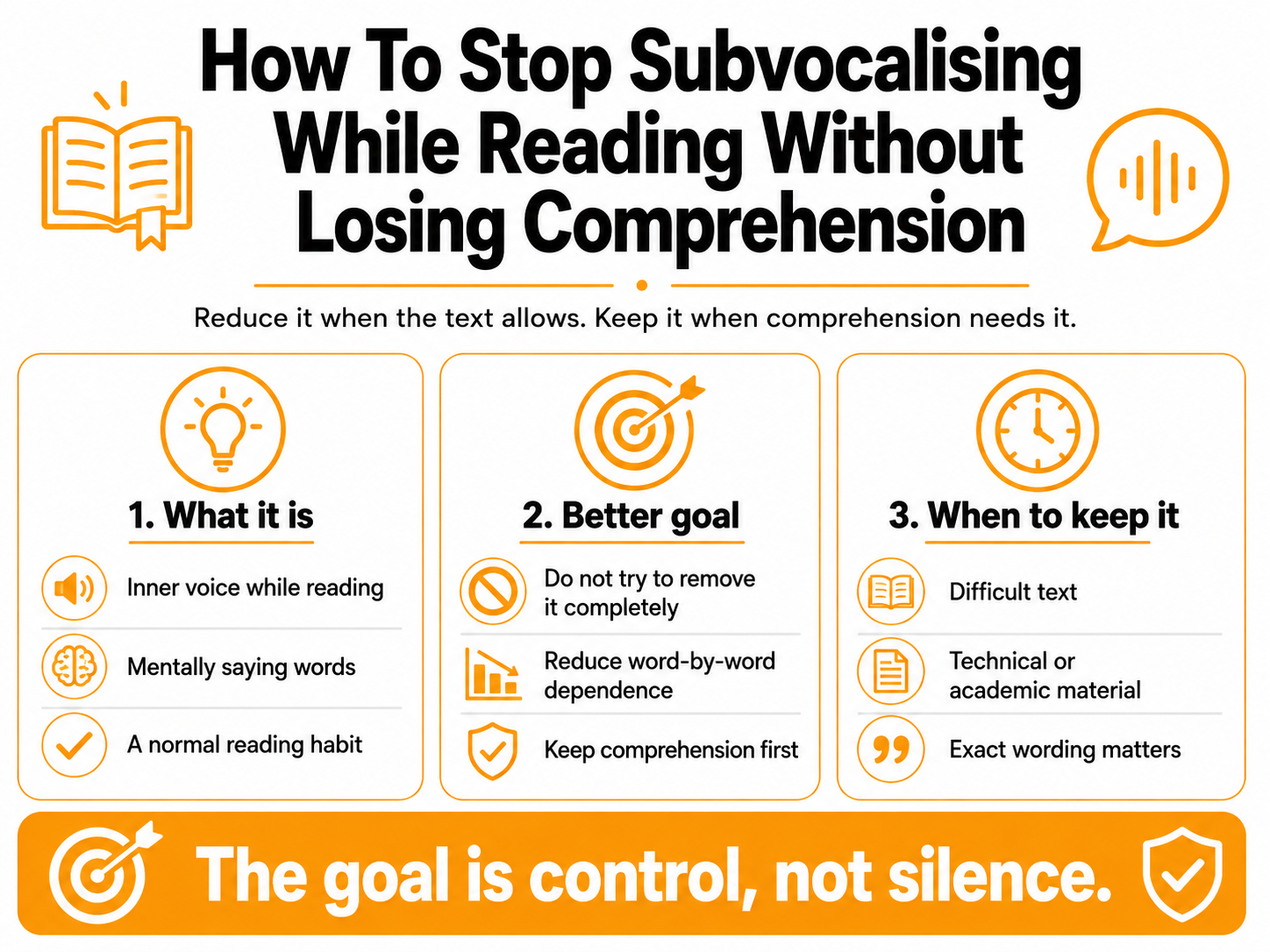
You usually cannot stop subvocalising completely, and you do not need to.
A better goal is to reduce dependence on inner speech when reading simple, familiar, or low-risk material. You can do this by reading in phrases, using a steady pace, focusing on meaning instead of individual words, and checking comprehension as you practise.
Do not force yourself to remove subvocalising on difficult text. If the material is technical, academic, legal, or unfamiliar, inner speech may help you understand it properly.
{{EMBED}}
Subvocalising is the silent speech that happens while you read.
Instead of saying the words out loud, you hear or feel them internally. It can feel like a quiet voice in your head, a slight movement pattern in your mouth or throat, or a mental rhythm that follows each word.
This is a normal part of reading for many people.
The problem is not that subvocalising exists. The problem is when every word has to be mentally spoken before the reader can move on. That can make reading slower than it needs to be, especially on easy material.
Subvocalising is also sometimes called subvocalisation, silent speech, or inner voice while reading.
For most readers, completely stopping subvocalising is not realistic.
Reading is connected to language, sound, meaning, and memory. Even when you are reading silently, your brain may still use parts of the language system that are linked to speech.
Trying to remove inner speech completely can also backfire. Some readers become so focused on suppressing the voice that they stop paying attention to the meaning of the text.
A more useful target is control.
You want to reduce subvocalising when it slows you down, but allow it when it helps you understand, remember, or think carefully.
Subvocalising can slow reading when it makes your pace depend on spoken speed.
If you mentally pronounce every word, your reading may stay close to the speed of speech. That can be useful for careful reading, but it is not always necessary for simple articles, familiar notes, emails, or general material.
It can also make readers give equal attention to every word. That creates a slow rhythm even when some parts of the text only need light processing.
The issue is not inner speech itself. The issue is overdependence.
If your reading cannot move unless the inner voice says every word, you have less flexibility. That affects pace, focus, and reading efficiency.
Our guide to what makes a good reading speed explains why WPM should always be judged alongside comprehension.
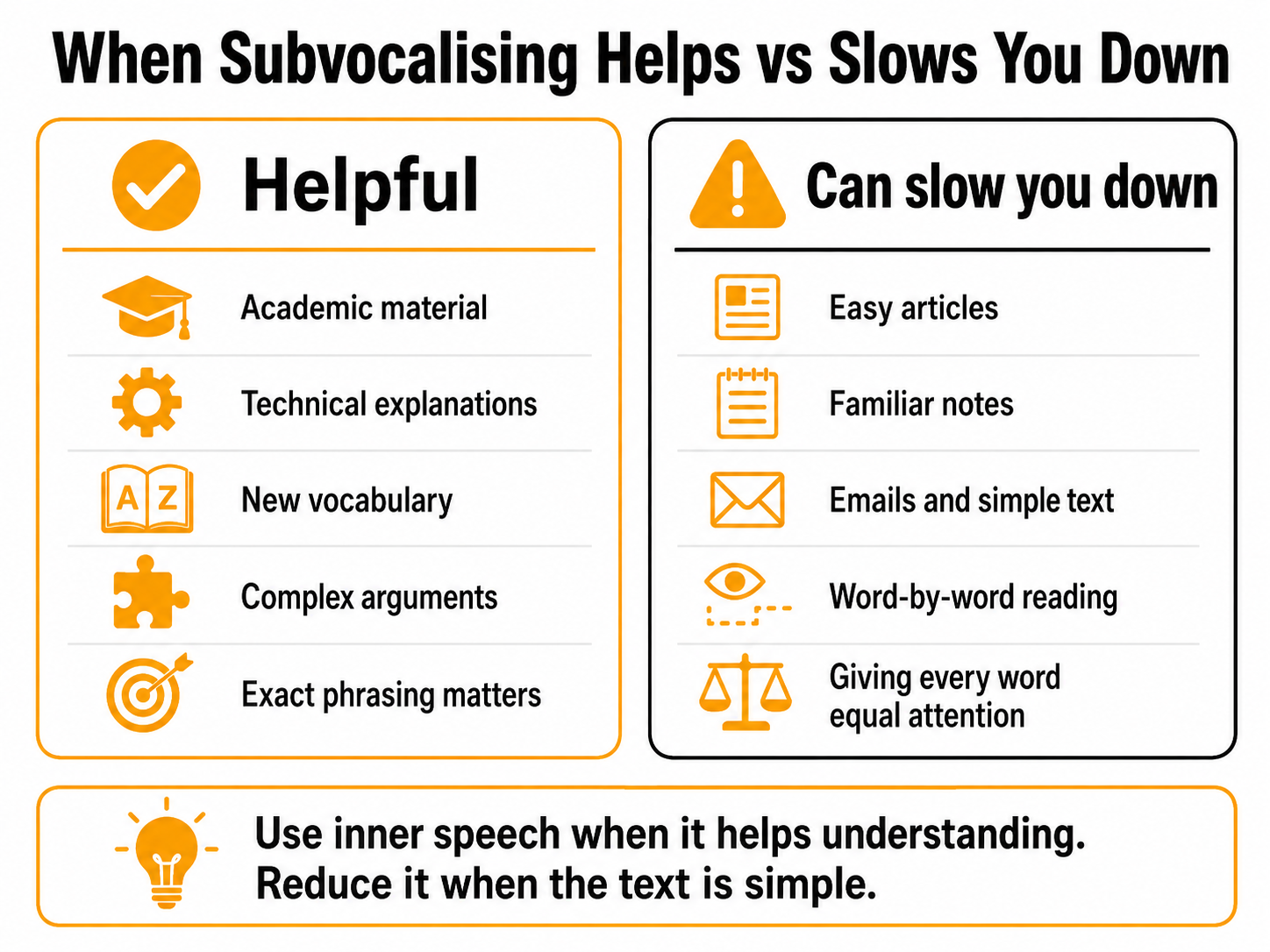
Subvocalising is not something to fight in every situation.
It can help when the text is difficult, unfamiliar, detailed, or important. Inner speech can support attention, phrasing, memory, and careful understanding.
It is often useful for:
In these cases, trying to read without any inner voice may reduce comprehension.
Strong readers do not remove subvocalising completely. They know when to rely on it and when to reduce it.
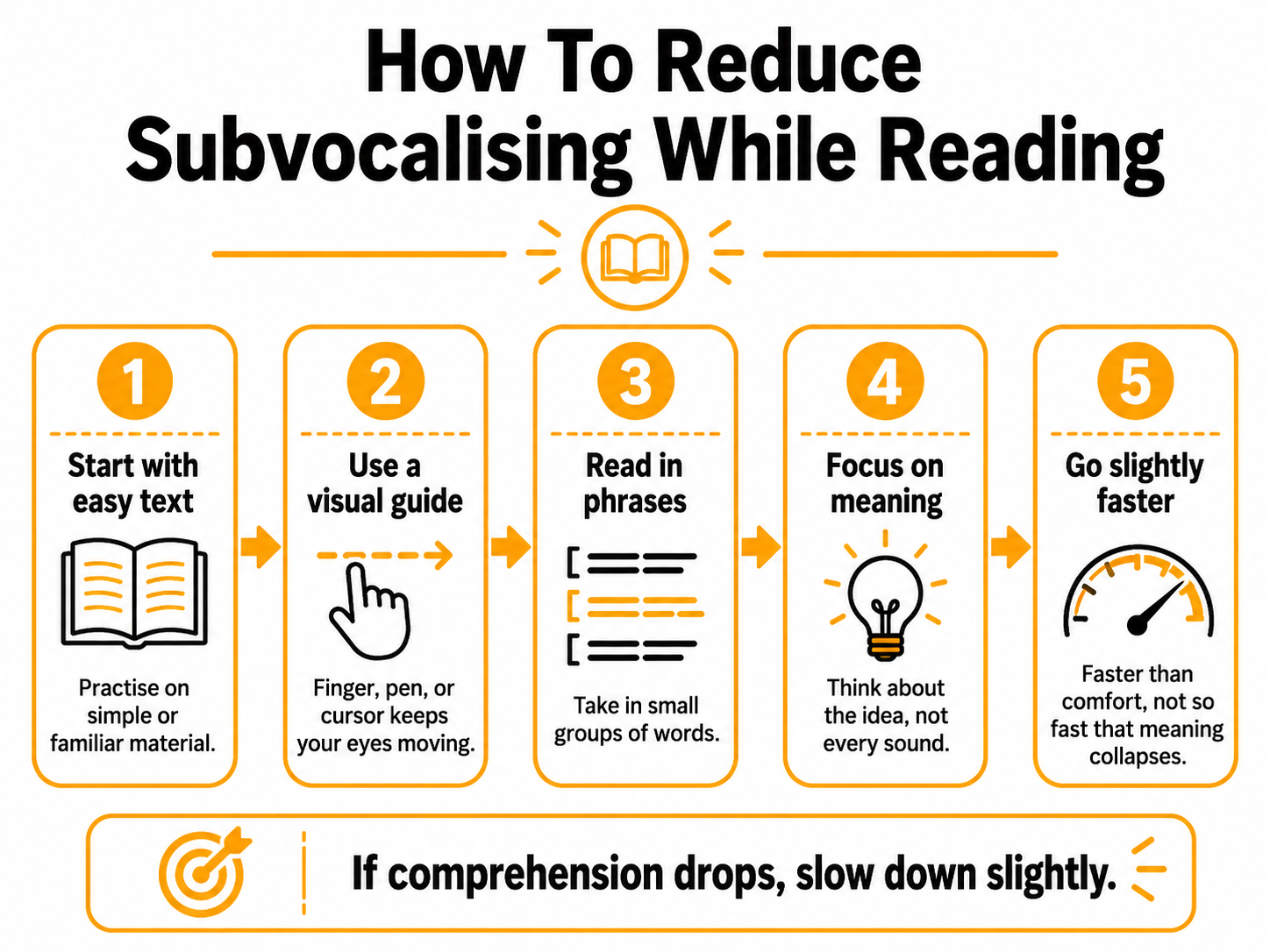
The best way to reduce subvocalising is to practise on suitable material.
Start with simple or familiar text. Do not practise on legal documents, dense textbooks, or anything where exact wording matters.
Use a steady visual pace. A finger, pen, cursor, or guided line can help your eyes move forward instead of stopping on every word.
Try reading in phrases instead of single words. For example, instead of mentally saying each word separately, aim to take in small groups of words as units of meaning.
Focus on the idea of the sentence, not the sound of every word. Ask yourself what the sentence means, not how each word sounds internally.
You can also practise slightly faster than your comfort pace. Not so fast that comprehension collapses, but fast enough that your inner voice cannot fully pronounce every word.
For a wider breakdown of practical methods, read our guide on which techniques help increase reading speed.
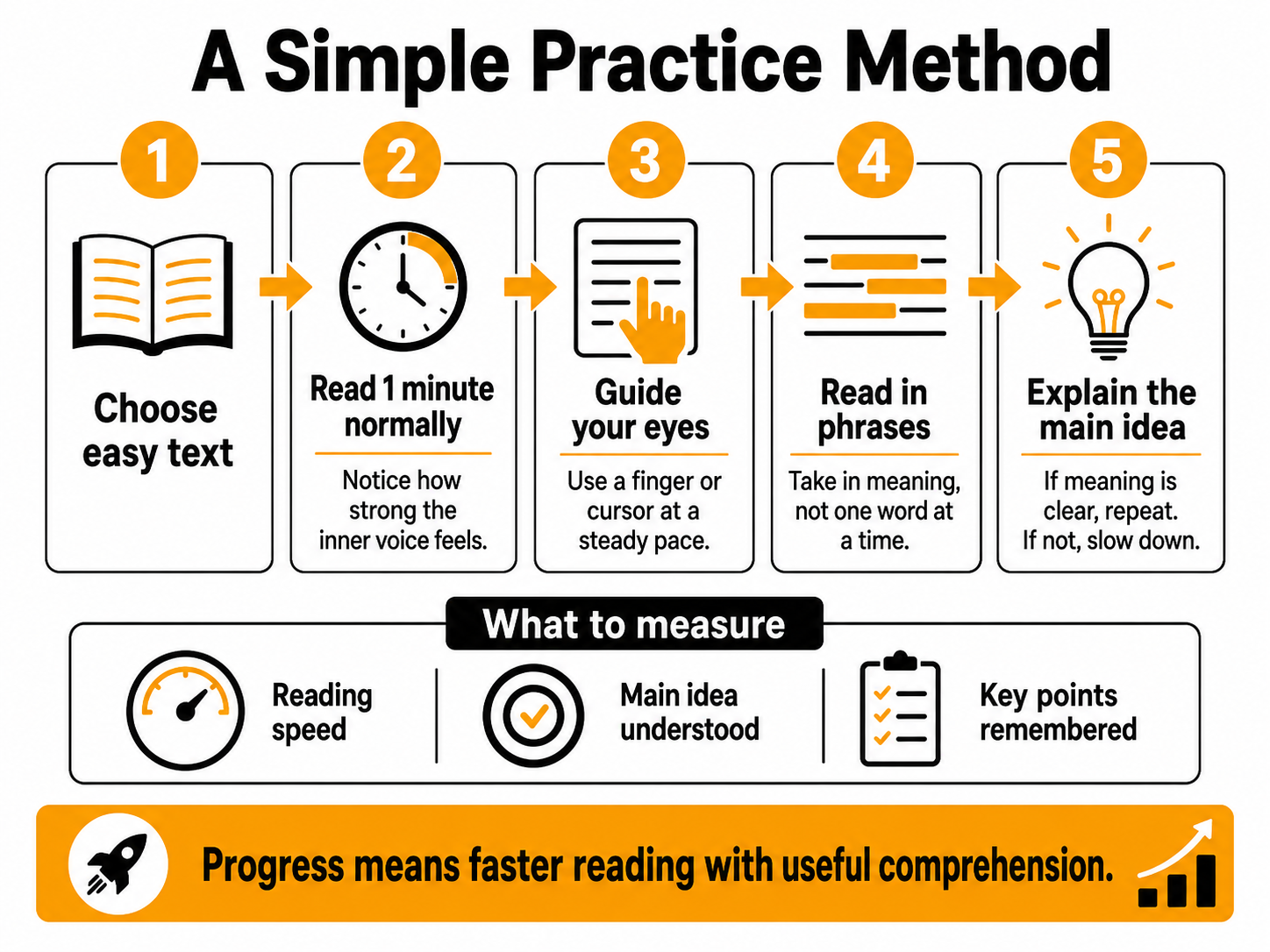
Use this short drill for five minutes.
Choose an easy article or familiar passage.
First, read for one minute at your normal pace and notice how strong the inner voice feels.
Next, read another section using a finger or cursor to guide your eyes at a steady pace.
Then, try to take in phrases instead of individual words.
After that, pause and explain the main idea in your own words.
If you understand the passage, repeat the drill. If you lose the meaning, slow down slightly.
The goal is not to remove every trace of inner speech. The goal is to reduce unnecessary word-by-word reading while keeping comprehension intact.
Do not judge progress by speed alone.
If you read faster but cannot explain what you read, the practice is not working.
Track three things:
You should also compare similar text types. A simple article and a dense textbook chapter are not the same reading task.
Good progress means you can move faster on suitable material without losing the level of understanding you need.
The biggest mistake is trying to eliminate subvocalising completely.
That often makes readers tense, distracted, and less aware of meaning.
Another mistake is practising on material that is too difficult. If the text needs careful thought, slower reading may be the correct choice.
Some readers also confuse reduced subvocalising with skimming. Moving quickly through a page and catching the general idea is not the same as reading with useful comprehension.
If you are unsure about the difference, read our guide on speed reading vs skimming.
The final mistake is chasing speed before building control. Subvocalising work should improve reading judgement, not make you rush every text.
Do not try to reduce subvocalising when the wording matters.
Slow down when reading legal, medical, financial, technical, academic, or highly detailed material.
Also slow down when studying something new, analysing an argument, or reading material that needs reflection.
In these situations, inner speech may support comprehension. Removing it can make the reading faster on the surface but weaker in meaning.
A strong reader knows when to let the inner voice help.
Subvocalising is not the enemy.
It is a normal part of reading, and in many situations it helps understanding. The problem is relying on it too heavily when the material does not need slow word-by-word processing.
The best approach is not to stop subvocalising completely. It is to reduce unnecessary inner speech on suitable material, read in phrases, keep a steady pace, and check comprehension as you practise.
If inner speech, rereading, or poor pacing is holding you back, StudyFast’s Speed Reading Mastery course can help you build a more controlled approach to reading faster without losing understanding.
Subvocalising is the inner voice or silent speech that happens when you read silently. It means you mentally say words as you read them.
No. Subvocalising is not always bad. It can help comprehension, especially with difficult or detailed material. It only becomes a problem when it slows every type of reading unnecessarily.
Most readers cannot stop it completely, and they do not need to. A better goal is to reduce dependence on inner speech when reading simple or familiar material.
It can slow reading if you mentally pronounce every word. This can keep your reading close to speaking speed, which may be slower than necessary for easier material.
Practise on easy text, use a steady visual guide, read in phrases, focus on meaning, and check comprehension after each short passage.
Often, yes. When studying difficult or unfamiliar material, subvocalising can help attention and comprehension. It should not be forced out if it supports understanding.
No. Reading aloud uses your voice. Subvocalising is silent and happens internally, although some readers may feel slight mouth or throat movement.